
연구분야
Prof. Jeong-Eun Lee
Star formation begins with the gravitational collapse of a dense molecular cloud. The protostar that forms at the center of the cloud grows by accreting material from its surrounding envelope through a protostellar disk, and a new star is born when hydrogen burning is ignited in its core. The dynamical processes of star formation occur on timescales that are very short compared to those of stellar evolution. During this phase, physical conditions such as density and temperature in the collapsing cloud and accretion disk vary significantly as the protostar builds up its mass. As a result, the chemical conditions of the associated material also evolve. Chemistry therefore provides important diagnostics for probing the dynamical processes and physical structures associated with star formation.
Professor Lee’s group studies the dynamics, energetics, and chemistry of star formation through multi-wavelength observations and modeling of the physical and chemical structures of young stellar objects. Her team utilizes (sub-)millimeter facilities such as the Atacama Large Millimeter/submillimeter Array (ALMA), as well as space-based observatories including the James Webb Space Telescope (JWST), to investigate the inventory of complex organic molecules—the building blocks of prebiotic molecules—in protostellar envelopes and protoplanetary disks.
[Group Homepage] http://starformation.synology.me/
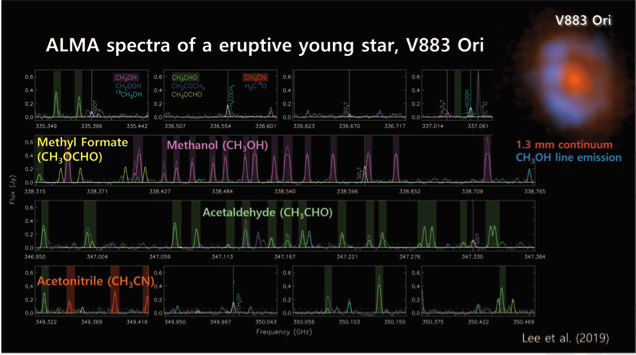
ALMA image and spectra of thte protoplanetary disk around an eruptive young star, V883 Ori.
The orange and skyblue images in the top right present the dust continuum and methanol line emission, respectively. In the spectra, the gray line presents the observed spectra, while different colors show the modeled spectra of diffenent complex organic molecules. This spectra revealed various complex organic molecules in the material associated with planet formation, for the first time.
