
Research News
Total 12건
-
 Our Data from Our Telescopes — Now Distributed Worldwide
Our Data from Our Telescopes — Now Distributed Worldwide A large-scale survey carried out with KMTNet, a Korean observing facility, is being shared with astronomers around the world through international data centers — and will serve as the standard reference imaging dataset for the southern sky. Astronomical observations produced by a Korean research team using a domestic observing facility have been released to astronomers around the world through major international data centers. The research team led by Prof. Myungshin Im (Department of Physics and Astronomy, Seoul National University [SNU]; President Hong-Lim Ryu) has released a deep, uniform imaging map of the southern sky and an accompanying source catalog — obtained through a wide-area survey carried out with the Korea Microlensing Telescope Network (KMTNet), developed and operated by the Korea Astronomy and Space Science Institute (KASI; President Jang-Hyun Park). The data are now publicly available worldwide through two major international astronomical data centers: the Astro Data Lab at NSF NOIRLab* in the United States, and the Centre de Données astronomiques de Strasbourg (CDS)** in France. * NOIRLab: the U.S. National Science Foundation's National Optical-Infrared Astronomy Research Laboratory. Astro Data Lab is a data platform operated by NOIRLab's Community Science and Data Center (CSDC). ** CDS: the Centre de Données astronomiques de Strasbourg, operated jointly by the University of Strasbourg and the Centre National de la Recherche Scientifique (CNRS) of France. Through KMTNet's open observing program, the team launched KS4 (KMTNet Synoptic Survey of Southern Sky) in 2019 and has since carried out more than 600 nights of observations. The extensive data obtained from KMTNet's three identical telescopes — at CTIO (Chile), SAAO (South Africa), and SSO (Australia) — were processed into science-grade products using a dedicated pipeline developed at SNU, producing a catalog of more than 200 million southern-hemisphere sources along with high-quality images ready for scientific use. With this release through international data centers, anyone in the world can now access the KS4 data, free of charge. On August 17, 2017, the LIGO and Virgo gravitational-wave detectors recorded GW170817, a gravitational-wave signal from a binary neutron star merger. Eleven hours later, its optical counterpart — a kilonova — was identified, marking the first multi-messenger observation. Identifying such transient phenomena against the dense background of known sources, however, requires deep and uniform reference images of the pre-event sky — something the southern hemisphere had been lacking. The KS4 survey was launched to meet this need, and its imaging will serve as a reference dataset enabling rapid identification of optical counterparts in future gravitational-wave events. Among existing southern-sky surveys, Gaia (European Space Agency) and the Australian-led SkyMapper cover the sky uniformly but are limited to relatively bright sources. The U.S.-led DELVE (DECam Local Volume Exploration) and Legacy Survey, in contrast, reach fainter sources but have uneven sky coverage with some gaps. KS4 effectively fills this gap: its depth (roughly 22–23.5 magnitudes) is well matched to the detection of transient phenomena such as gravitational-wave optical counterparts, while providing uniform, gap-free coverage. KS4 also employs the classical B, V, R, and I filters that have long been standard in observational astronomy — a filter combination offered by no other current wide-area survey. Prof. Myungshin Im, who leads the project, noted: "Until now, large-scale optical surveys of the southern sky have been led by institutions in the United States, Australia, and Europe. KS4 is a major survey carried out with KMTNet — a facility built and operated by Korea itself." He added: "The release of the KS4 dataset marks Korea's transition from being a consumer of astronomical data produced abroad to a provider of such data to the world — a milestone that symbolizes how Korea's astronomy and space science has come of age." Dr. Seo-Won Chang (Research Professor, SNU), who led the data release effort, emphasized: "This is a valuable case in which southern-sky observational data we produced have been recognized for their significance and made public through major international astronomical data centers. This is the first time that a large-scale dataset from Korean ground-based telescopes has been released to the global astronomical community through major international data centers." Dr. Chung-Uk Lee, Head of the Exoplanet Research Center at the Korea Astronomy and Space Science Institute, stated: "KMTNet is composed of three identical facilities that together enable continuous 24-hour monitoring. These data have already been used in the search for optical counterparts of gamma-ray bursts and gravitational-wave events, and they will be an indispensable reference dataset for transient science in the Rubin/LSST era." Beginning with this first data release, the team plans to continue observations through the remainder of the approved observing period, which runs to December 2029. — End of press release; supplementary materials follow (see Appendix 1 & Appendix 2 tabs) — Appendix 1: Public Survey Data and Data Centers □ Featured Image and Description Figure 1. KS4 image of the elliptical galaxy NGC 4696 and the surrounding Centaurus galaxy cluster. Thanks to the wide field of view of KS4, the densely populated cluster environment and the bright central galaxy can be easily captured in a single frame. [Field of view: 1.31° × 0.71°; colour composite from B, V, I bands. Color and contrast adjusted, and image artifacts removed, for visualisation. Credit: Seo-Won Chang & Mankeun Jeong (Seoul National University)] Figure 2. The spiral galaxy NGC 2442. The high resolution of KS4 reveals the asymmetrically warped spiral arm structure and the distribution of interstellar dust lanes. [Field of view: 21.1′ × 11.5′; colour composite from B, V, I bands. Color and contrast adjusted, and image artifacts removed, for visualisation. Credit: Seo-Won Chang & Mankeun Jeong (Seoul National University)] Figure 3. The disc galaxy NGC 5292. The stable disc structure and the distribution of surrounding galaxies can be seen. [Field of view: 9.42′ × 5.15′; colour composite from B, V, I bands. Color and contrast adjusted, and image artifacts removed, for visualisation. Credit: Seo-Won Chang & Mankeun Jeong (Seoul National University)] Figure 4. The merging galaxies NGC 5291 and NGC 5291B (center), members of the Abell 3574 cluster. The arc-shaped structures of small, bluish objects extending above and below NGC 5291 are tidal dwarf galaxies — newly formed stellar systems produced by tidal interactions during a past merger with another galaxy. [Field of view: 18.4′ × 10.1′; colour composite from B, V, I bands. Color and contrast adjusted, and image artifacts removed, for visualisation. Credit: Seo-Won Chang & Mankeun Jeong (Seoul National University)] Figure 5. A field observed near the Galactic plane. The field is densely packed with stars belonging to our Milky Way, among which background galaxies and various other objects are also captured. [Field of view: 1.42° × 0.83°; colour composite from B, V, I bands. Colour and contrast adjusted, and image artefacts removed, for visualisation. Credit: Seo-Won Chang & Mankeun Jeong (Seoul National University)] Figure 6. A southern-sky map showing the KS4 survey footprint. The map indicates the area publicly released to the global astronomical community in this data release (red) and the full survey area observed to date (grey). The center of the map is the South Celestial Pole. The survey densely scans the sky south of declination −30°, including the Large and Small Magellanic Clouds, neighbouring galaxies of our Milky Way. [Credit: Seo-Won Chang & Mankeun Jeong (Seoul National University)] Figure 7. Comparison of KS4 and other survey images (a zoomed-in region of the Centaurus cluster shown in Figure 1). The KS4 image (a) is deeper than the SkyMapper image (b) and, unlike the Legacy Survey image (c), does not contain the black rectangular gaps of uncovered sky. This makes KS4 particularly well suited as a reference image for transient searches. [Credit: Seo-Won Chang / Mankeun Jeong (Seoul National University)] □ Public Data Centers < Images > KS4 imaging is distributed through the Centre de Données astronomiques de Strasbourg (CDS, France) in HiPS (Hierarchical Progressive Survey) format. HiPS reorganizes large astronomical images into a multi-resolution tile structure: as users pan across the full sky and zoom into a region of interest, progressively higher-resolution imagery is loaded automatically. Without installing any dedicated software, users can freely explore BVI color images of the southern sky as well as the individual B, V, R, and I band images directly from a web browser. The imagery can also be viewed directly in major astronomical data exploration tools such as Aladin Desktop, Aladin Lite (CDS), and ESASky (ESA). BVI color image: https://alasky.cds.unistra.fr/KS4/DR1/SNU_P_KS4_DR1_colorBVI/ B band: https://alasky.cds.unistra.fr/KS4/DR1/SNU_P_KS4_DR1_B/ V band: https://alasky.cds.unistra.fr/KS4/DR1/SNU_P_KS4_DR1_V/ R band: https://alasky.cds.unistra.fr/KS4/DR1/SNU_P_KS4_DR1_R/ I band: https://alasky.cds.unistra.fr/KS4/DR1/SNU_P_KS4_DR1_I/ < Source Catalogs > Two catalogs, together containing information on more than 200 million celestial sources, are distributed through the Astro Data Lab at NSF NOIRLab (USA). The first is a forced-photometry catalog (~228 million sources), in which source positions detected in the I-band images are used as reference positions at which photometry is performed in the B, V, and R bands. The second is a band-merged catalog (~280 million sources), which combines sources detected independently in each band and therefore includes a larger number of objects, such as faint blue sources missed in the I band. Users can query the catalogs with SQL (Structured Query Language) to select only the sources matching their criteria. Pre-cross-matched tables against major optical and infrared catalogs — including Gaia DR3 and ALLWISE — are also provided. Astro Data Lab: https://datalab.noirlab.edu/data/ks4 I-band-referenced catalog: https://datalab.noirlab.edu/data-explorer?showTable=ks4_dr1.idual_master Band-merged catalog: https://datalab.noirlab.edu/data-explorer?showTable=ks4_dr1.single_master The band-merged catalog is also searchable and downloadable through the CDS VizieR service. CDS VizieR: https://vizier.cds.unistra.fr/ ※ All data are freely accessible to anyone through these international data centers. □ Publications and Research Team - Publications: (1) KMTNet Synoptic Survey of Southern Sky II: Data Reduction and Real-Time Transient Detection Pipeline, Journal of the Korean Astronomical Society (SCIE), published April 9, 2026. (2) KMTNet Synoptic Survey of Southern Sky III: The First Data Release, Journal of the Korean Astronomical Society (SCIE), published April 9, 2026. - Research Team: Myungshin Im, Seo-Won Chang, Mankeun Jeong, Seungho Jung, Bomi Park, Jaewon Lee, Changwan Kim, Ji hoon Kim, Seong-Kook Lee, and Ji Seop Shin (Seoul National University); Chung-Uk Lee and Dong-Jin Kim (Korea Astronomy and Space Science Institute); JoonHo Kim (Daegu National Science Museum); Yongjung Kim (Sejong University); David A. H. Buckley (South African Astronomical Observatory, South Africa); Jeff Cooke (Swinburne University of Technology, Australia); Gregory S. H. Paek (University of Hawaii, USA); and others — 17 co-authors in total. Appendix 2: Supplementary Information on KMTNet and KS4 □ The Korea Microlensing Telescope Network(KMTNet) KMTNet is a telescope system dedicated to the search for extrasolar planets, whose development was launched in 2009 as a principal project of the Korea Astronomy and Space Science Institute (KASI). The system was developed to search for exoplanets with Earth-like environments capable of harboring life, and was installed in May 2015 at three southern-hemisphere observatories: Cerro Tololo Inter-American Observatory (CTIO) in Chile, the South African Astronomical Observatory (SAAO) in South Africa, and Siding Spring Observatory (SSO) in Australia. Optimized for exoplanet detection via gravitational microlensing, KMTNet began full science operations on October 2, 2015, following several months of commissioning observations. The three southern-hemisphere observatories are separated by roughly 120° in longitude — corresponding to about eight hours in local standard time — so that as observations wrap up at the Chilean site, they begin in Australia, and as observations end in Australia, they are picked up in South Africa. This makes KMTNet the world's first exoplanet survey system capable of 24-hour continuous monitoring, taking full advantage of these time-zone offsets for efficient observing. ※ KMTNet website: http://kmtnet.kasi.re.kr/kmtnet/ ※ KMTNet media files (video): https://drive.google.com/file/d/1s3h32bbP_FH-uooQJk35ZZ7MPPwsUEdz/view?usp=sharing □ KS4 (KMTNet Synoptic Survey of Southern Sky) KS4 is a survey project that systematically images the entire southern sky by exploiting the wide field of view (2° × 2°) of KMTNet. Led by Prof. Myungshin Im of Seoul National University as Principal Investigator, the survey has been carried out through the KMTNet open call observing program in Phase 1 (Nov 2019 – Sep 2020), Phase 2 (Oct 2020 – Sep 2023), and Phase 3 (Oct 2023 – Dec 2026), with Phase 4 (Jan 2027 – Dec 2029) submitted as well, making it a long-term survey spanning ten years in total. The first observations were taken at SAAO in South Africa in November 2019. Full-scale operations began in October 2020, when all three sites — Chile, South Africa, and Australia — became active. The survey area covers declinations of −85° < Dec < −28.8°, dividing the southern sky into 2,749 tiles. Each tile is observed for 120 seconds in each of the four filters (B, V, R, I), with at least four repeat exposures. The four exposures are taken using a dithering technique (in which the telescope pointing is shifted slightly between exposures) to fill the gaps between CCD chips and produce contiguous imaging with no missing regions. The first data release presented here (DR1, Data Release 1) comprises observations taken between November 2019 and December 2023, covering 979 tiles and approximately 4,000 square degrees. A total of 17,626 exposures were obtained, corresponding to 589 hours of observing time. The 5σ limiting magnitudes are B = 22.7, V = 22.6, R = 22.8, and I = 22.1 AB mag. Raw data collected at the three observatories are first preprocessed at the KASI, and then processed into science-grade data through a dedicated KS4 pipeline developed by the SNU research team. Key processing steps include correction of CCD detector artifacts, Gaia-based astrometric calibration, uniform photometric calibration using a two-dimensional zero-point correction map, and the generation of deep reference images by combining data from the three sites (Jeong et al. 2026, Chang et al. 2026). To date, the total area observed under KS4 is approximately 6,700 square degrees. The remaining area will be released in DR2, which is also planned to include photometric data from individual single-epoch images, enabling analyses for time-domain astronomy research.
2026-05-08
Read More -
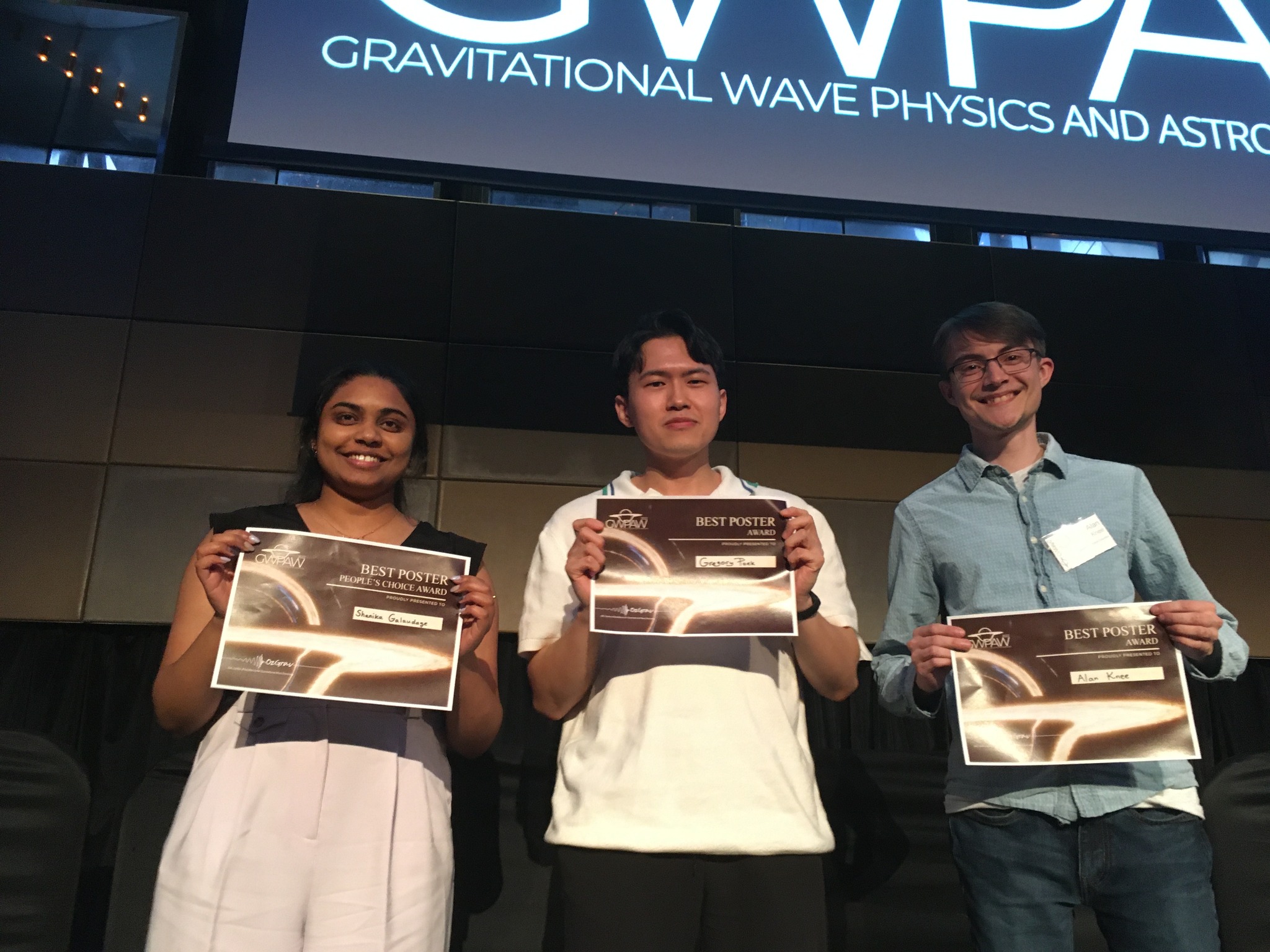 Gregory S.H. Paek (a SNU grad student) receives the best poster award from an International Workshop
Gregory S.H. Paek, a SNU student from the astronomy graduate program, receives the best poster award from the international workshop "Gravitational Wave Physics and Astronomy Workshop 2022 (GWPAW, link)" in December 9th, 2022. The workshop was held in Melbourne, Austrailia in December 5th to 9th, 2022, hosted by OzGrav (ARC Centre of Excellence for Gravitational Wave Discovery), the Australian Research Council Centre of Excellence for Gravitational Wave Discovery. Gregory S.H. Peak presented a poster about the detection of Kilonovas using 7DT project, which he has worked with Prof. Myungshin Im and Dr. Ji Hoon Kim (SNU astronomy program). He won "Winners of best posters at GWPAW Melbourne" with 1000 AUD price money. Below is the abstract of his presentation: Identifying the electromagnetic counterparts of gravitational waves (GW), namely kilonovae, is a crucial step toward the success of GW multi-messenger astronomy. In this poster, we introduce the 7-Dimensional Telescope (7DT; PI: Prof. Myungshin Im), the biggest ground-based multi-telescope system designed to efficiently and rapidly search for these counterparts. Its unique feature is the use of 20-40 medium-band filters on each of its 20 independent telescopes, allowing for wide-field, low-resolution spectral imaging, which is a powerful tool in identifying and distinguishing kilonovae from other astronomical sources. We present the results of our experiments demonstrating how robust 7DT can detect and classify kilonovae. This research was supported by the Center for the Gravitational-Wave Universe granted by National Science Challenge Initiatives (NSCN). Congratulations, Gregory!
2023-03-23
Read More -
 Breakthrough Prize For Event Horizon Telescope Collaboration
Prof. Sascha Trippe The Event Horizon Telescope (EHT) Collaboration, including Prof. Sascha Trippe of Seoul National University, has been awarded the 2020 Breakthrough Prize in Fundamental Physics. The prize money of 3 million USD will be split equally among the collaboration members. The EHT is a global network of radio observatories dedicated to the observation of supermassive black holes and active galactic nuclei. In April 2019, the EHT Collaboration released the first image of the shadow of the 6-billion solar mass black hole in the galaxy M 87, located at a distance of about 54 million light years. This groundbreaking achievement has now been recognized. Announcement of the Breakthrough Prize: https://breakthroughprize.org/News/54 Information on the EHT: https://eventhorizontelescope.org/
2019-09-09
Read More -
 Researchers discover that a giant smash of galaxy clusters forms bar structure in spiral galaxies
Researchers discover that a giant smash of galaxy clusters forms bar structure in spiral galaxies Prof. Myunhshin Im (Advisor/Corresponding author) PhD stedent Yongmin Yoon (first author) Researchers in Korea reported in 2019 June 24th issue of Nature Astronomy that a giant smash of two clusters of galaxies can form bar structure, an important structure inside many spiral galaxies. It has been known that galaxies, systems made of hundreds of billions of stars, can take many different shapes. The reason why galaxies take many different shapes has been one of the most important questions in Astronomy during the past 100 years. The most common kind of galaxies is spiral galaxies that have spiral arms, and about one third of spiral galaxies are known to have a structure called “bar”. Bar structure is an elongated structure that extends from the central region of a galaxy, and bar has been known to play a key role in regulating star formation and nuclear black hole growth. Furthermore, bar has been suggested as a structure responsible for forming another important galactic structure called “bulge”, a central concentration of stars in elliptical shape. Therefore, the formation mechanism of bar has been a central issue for understanding the galaxy formation and evolution. Previous studies have suggested two key mechanisms for bar formation, one that is driven by the internal dynamical instability of galaxies (internal mechanism), and another due to interaction of a galaxy with other galaxies in the neighbor (environmental mechanism). However, the exact physical mechanism for the bar formation has been in debate. In this new study, the research group led by Prof. Myungshin Im and Mr. Yongmin Yoon at Seoul National University identified a completely new mechanism that can form bars in spiral galaxies - interaction of two galaxy clusters. Galaxy clusters are the most massive gravitationally bound objects in the universe, that are made of hundreds to thousands of galaxies. When such massive monsters collide with each other, the colliding system exerts a rapid and strong change in the gravitational force on galaxies that belong to the clusters. This rapid change of the gravitational force can induce instability in spiral galaxy structure and causes bars to form. The researchers identified 105 galaxy clusters and 1377 spiral galaxies belonging to the clusters, and identified bar spiral galaxies among them. To their surprise, bar spiral galaxies are by 1.5 times more frequently found in interacting clusters than in non-interacting clusters. The researchers then examined if other mechanisms that follow the galaxy cluster interaction can be responsible for the bar formation, e.g. galaxy-galaxy interaction during the cluster interaction, but found no observational evidence that any derivative mechanisms are responsible for the enhancement of the bar fraction in the interacting clusters. Therefore, they concluded that the enhancement of the bar fraction in the interacting clusters is due to the cluster interaction itself. The discovery is rather unexpected, and provides a fresh, new view on how galaxy shape are determined. When studying galaxy shapes, previous studies focused on internal physical parameters such as galaxy mass or static environmental parameters such as mass density of the environment. However, the new result suggests that the rapid and violent change of the large scale environment such as galaxy cluster interaction must be additionally considered seriously when understanding galaxy shapes. Myungshin Im notes that “This result provides a very new perspective to the study of galaxy shapes, and could galvanize this field.”. The bar structure may not be the only thing that has been induced by galaxy cluster interaction. Other physical properties of galaxies, such as how strongly they form stars, could be affected as well. “We are now looking into how galaxy cluster interaction changes many other properties of galaxies.”, Yongmin Yoon adds. Just like human society, violent change in the environment at large scale seems to change the lives of galaxies in the universe. This research was supported by the National Research Foundation of Korea. Examples of an interacting galaxy cluster, Abell 520 (top figure), a non-bar spiral galaxy M81 (bottom left), and a bar spiral galaxy NGC 1300 (bottom right). A violent interaction of the universe’s most massive structures, galaxy clusters (top), can induce bars in spiral galaxies as illustrated in the bottom. This is the first time such a mechanism has been observationally proven to be responsible for the formation of bars in spiral galaxies. Figure credits Whole diagram: CEOU, Seoul National University Abell 520: NASA, ESA, CFHT, CXO, M.J. Jee (University of California, Davis), and A. Mahdavi (San Francisco State University) M81: NASA, ESA and the Hubble Heritage Team (STScI/AURA). Acknowledgment: A. Zezas and J. Huchra (Harvard-Smithsonian Center for Astrophysics) NGC 1300: NASA, ESA, and The Hubble Heritage Team (STScI/AURA), P. Knezek (WIYN) [Reference] Yongmin Yoon, Myungshin Im, Gwang-Ho Lee, Seong-Kook Lee, and Gu Lim, Nature Astronomy, 10.1038/s41550-019-0799-7 [Main Author] Myugnshin Im(Seoul National University), Yongmin Yoon(Seoul National University) * Contact : Myungshin Im myungshin.im@gmail.com Yongmin Yoon yymx2@astro.snu.ac.kr
2019-07-05
Read More -
 THE VARIABILITY TIME SCALE - ACCRETION RATE RELATION OF ACTIVE GALACTIC NUCLEI
THE VARIABILITY TIME SCALE - ACCRETION RATE RELATION OF ACTIVE GALACTIC NUCLEI PhD stedent Jongho Park (first author) Prof. Sascha Trippe (Advisor/Corresponding author) Active galactic nuclei (AGN) are the strongest sources of energy in the universe, being up to 10,000 times brighter than our home galaxy, the Milky Way. Their radiation is powered by accretion of interstellar gas into supermassive black holes located in the centers of galaxies; each of those black holes has a mass of a few million to a few billion times the mass of the sun. The brightness of AGN is highly variable and can change by more than one order of magnitude within few years. The amount of variability is stronger over longer time scales and shows no periodicities. In statistics terms, AGN are sources of "red noise": the power of variability is proportional to the sampling frequency (or inverse variability time scale) taken to a power beta, with beta being smaller than zero. SNU PhD student Jongho Park and Prof. Sascha Trippe analyzed the radio light curves of 43 bright AGN. The light curves, which were provided by the University of Michigan Radio Astronomy Observatory (UMRAO), span about 30 years in time. Park and Trippe calculated the power law indices beta for each light curve and searched for correlations with the physical properties of the target AGN (like, e.g., black hole mass). Surprisingly, their analysis found a correlation between beta and the accretion rate, which is the amount of mass a black hole accretes per time: beta is proportional to the accretion rate taken to the power of 0.25. In other words: if a black hole accretes more mass per time, variations of its brightness take more time. This new relation is not yet understood, and investigations of its cause continue. REFERENCE: Park, J. & Trippe, S. 2017, ApJ, 834, 157 [http://iopscience.iop.org/article/10.3847/1538-4357/834/2/157/meta] FIGURE CAPTION: The variability time scale - accretion rate relation in logarithmic representation, showing the time scale parameter beta (corrected for Doppler boosting) as function of accretion disk luminosity (accretion rate times squared light speed). The parameter alpha, shown in the left panel, is the slope of the best-fit line.
2017-03-15
Read More
